Critical Point
Definition
For a function a critical point of is a point in the domain of where its derivative is either zero or undefined. That is, is a critical point if or is undefined, for
Interpretation
Critical points are the points of the domain where the derivative gives no direction of increase or decrease: either , so the tangent is horizontal, or does not exist. They are the candidates for local extrema at interior points of the domain.
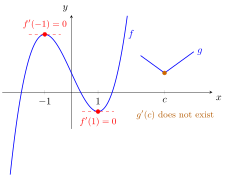
The figure shows both kinds. The cubic has , which is zero at and ; there the tangents are horizontal, and has a local maximum and a local minimum. The function has a corner at , where the slopes from the left and from the right differ, so does not exist.
Both kinds are collected because of the first-order condition: at an interior point where is differentiable, a local extremum forces . An interior local extremum is therefore either a point with or a point where is not differentiable, and in both cases a critical point. For a continuous function on , the critical points together with the endpoints and form the complete list of candidates for the global extrema guaranteed by the extreme value theorem.
The points with alone are the stationary points; for a differentiable function the two notions coincide.
Two slips are common. Solving alone misses the critical points where does not exist: has for all , yet its minimum is at . And a critical point must belong to the domain: has no derivative at , but is not a critical point, because is not defined there.
Key Results
- Local extrema at interior points of the domain can occur only at critical points; boundary points of the domain must be checked separately.
- Not every critical point corresponds to an extremum.
Examples
- For the point is a critical point.
- For the point is a critical point.
- For the point is a critical point where the derivative is undefined.
Prerequisites
Related Concepts
Sources
- Math I: Calculus · Lecture 6
Aliases: critical number Symbols: element of, real numbers, square root
Last updated: 20 October 2026 03:02
Critical PointSaddle PointUnconstrained Extrema ConditionsDerivative and DifferentiabilityLocal ExtremumFirst-Order ConditionStationary Point