Real Number
Definition
The set of all real numbers, denoted by is the complete ordered number system represented by the real number line. It contains the rational numbers, obeys the usual arithmetic and order rules, and has no gaps.
Completeness distinguishes from In this course it appears through the existence of suprema and through convergence theorems such as the monotone convergence theorem.
Each enlargement of the number systems removes a limitation of the previous one:
Natural numbers support counting, integers support unrestricted subtraction, rationals support division by nonzero numbers, and real numbers fill the gaps on the number line.
Interpretation
The real numbers are the points of the number line: every point corresponds to exactly one real number, and the line has no gaps. Real numbers fill the gaps left by the rationals, allowing geometric quantities, such as the diagonal of a unit square, to be represented exactly.
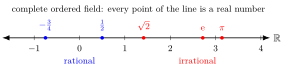
The figure places rationals ( and ) and irrationals (, and ) on the same line. Both kinds are needed: without the irrational points the line would have holes, for example at the positive number whose square is .
What a gap means can be seen in the Examples. The rational numbers , , , crowd closer and closer together, and their squares come closer and closer to , yet no rational number is the point they close in on. In that point exists: it is . Arithmetic and order alone do not distinguish from , since both follow the same rules for , and ; the absence of gaps is the difference. The Key Results state it precisely through least upper bounds, and it is what later makes limits of sequences work with exact numbers.
Key Results
- Every nonempty subset of that is bounded above has exactly one least upper bound; this existence statement is the defining advantage of over
- Every real number is either rational or irrational.
- The order on satisfies trichotomy and is preserved by addition and by multiplication with a positive number.
- Between any two distinct real numbers lies a rational number; this is the density of in
- The Archimedean property says that for positive real numbers and there is a positive integer with
Examples
- is a real number but not rational: no rational number squares to yet a real number does.
- the ratio of a circle's circumference to its diameter, is real but not rational.
- The approximations have squares approaching but the number they approach is missing from
Prerequisites
Related Concepts
Sources
- Math I: Calculus · Lecture 2
Aliases: real line, real number line Symbols: epsilon, integers, natural numbers, pi, rational numbers, real numbers, square root
Last updated: 27 October 2026 11:52
Real NumberAbsolute ValueCartesian Coordinate SystemExtended Real NumberFloor and Ceiling FunctionsFunctionInequalityIrrational NumberPeriodic FunctionTrichotomy of Real NumbersCardinality of the ContinuumComplex NumberRandom VariableRational NumberSupremumLimit of a SequenceEuclidean SpaceCauchy SequenceField