Cauchy Sequence
Definition
Enrichment: non-assessable in 2026-27
Cauchy sequences are presented in Math I: Calculus as enrichment. They are not assessable in 2026-27; the exam blueprint states this explicitly for the sets-and-sequences question.
A sequence of real numbers is a Cauchy sequence if, for every positive real number there exists an such that for all
Lecture 2 presents the same quantifier pattern first for rational sequences and positive rational Lecture 3 states the real-sequence version above. In either version, the essential point is that one choice of must work for every pair
Interpretation
A Cauchy sequence is one whose terms eventually become arbitrarily close to each other. The definition compares terms only with each other, never with a candidate limit, so it can be checked when the limit is unknown.
Compare it with the definition of a limit: convergence to asks for , the Cauchy condition for , where the absolute value is the distance between two terms. A convergent sequence is always Cauchy: if all terms from on lie within of , then by the triangle inequality any two of them lie within of each other. The converse is the Cauchy criterion of the Key Results, and it needs the real numbers: the decimal truncations of form a Cauchy sequence of rational numbers with no limit in .
The inequality in the definition bounds all pairs in the same tail; checking only consecutive differences is insufficient. For , the differences tend to , yet for every , so the sequence is not Cauchy.
In Math III the same definition is used with more general distances than : see Cauchy sequence in a metric space.
Key Results
- Cauchy criterion. A sequence of real numbers is convergent if and only if it is a Cauchy sequence. This relies on the completeness of (every nonempty set that is bounded above has a supremum) and fails in the course uses it as a criterion and does not construct from Cauchy sequences.
- The quantifier order matters: an arbitrary is given first, and only then is chosen so that all work.
Examples
- is a Cauchy sequence.
- is not a Cauchy sequence.
-
is a Cauchy sequence: given any integer works.
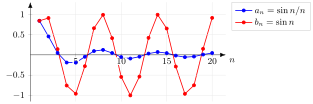
The terms of crowd together as grows (a Cauchy sequence); those of keep jumping across (not Cauchy).
Prerequisites
Related Concepts
- Limit of a Sequence
- Cauchy Sequence in a Metric Space
- Bounded Sequence
- Subsequence
- Subtraction and Difference
- Real Number
Sources
- Math I: Calculus · Lectures 2–3 (enrichment, non-assessable)
Aliases: fundamental sequence Symbols: epsilon, infinity, rational numbers, real numbers, square root
Last updated: 20 October 2026 03:02
Cauchy SequenceSequenceAbsolute ValueInequalityLimit of a SequenceCauchy Sequence in a Metric SpaceBounded SequenceSubsequenceSubtraction and DifferenceReal Number