Complete Metric Space
Definition
A metric space is termed complete if each Cauchy sequence contained within converges in . When a complete normed vector space is encountered, it's also referred to as a Banach space.
Interpretation
A complete metric space is one with no "missing points": every Cauchy sequence, a sequence that looks as if it should converge, actually has a limit inside the space.
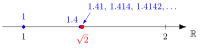
The displayed Cauchy sequence converges to in . It has no limit in because , illustrating the incompleteness of the rational numbers.
Completeness lets one prove that a limit exists without knowing it in advance: it is enough to show that the sequence is Cauchy. For it comes from the supremum property, which lacks: is bounded above but has no least upper bound in .
Completeness depends on the metric, not only on which sequences converge. On , the metric has the same convergent sequences as , because and its inverse are continuous. Yet is complete, since matches it with and its usual distance, while is not: is Cauchy for without a limit in the interval.
Every finite-dimensional real normed space, in particular with any norm, is complete, so the term Banach space matters mainly for spaces of functions: the bounded functions on a set, with the uniform norm, form a Banach space.
A common slip is to link completeness with boundedness. is unbounded and complete, while the bounded interval is not complete.
Key Results
- In any metric space every convergent sequence is a Cauchy sequence; in a complete metric space the converse also holds, so a sequence converges if and only if it is Cauchy.
Examples
- The Euclidean space is a complete normed vector space.
- The open interval with the usual metric is not complete: is a Cauchy sequence whose limit does not belong to
- The -dimensional real coordinate space equipped with the discrete metric is complete: a Cauchy sequence is eventually constant, because forces
Prerequisites
Related Concepts
Sources
- Math III: Analysis · Lecture 4
Aliases: complete space Symbols: element of, pi, rational numbers, real numbers, square root
Last updated: 20 October 2026 03:02
Complete Metric SpaceCauchy Sequence in a Metric SpaceConvergence in a Metric SpaceNorm and Normed Vector SpaceEuclidean Space