Boundary of a Set
Definition
For a metric space and a subset a point is a boundary point of if it's neither an interior nor an exterior point of We denote the set of boundary points of as
Interpretation
The boundary is the dividing line between inside and outside: it consists of the points that neither surrounds nor avoids. Relative to , every point of is of exactly one of three kinds: interior, exterior or boundary.
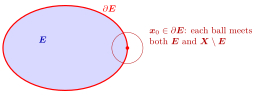
Each ball around the point in the figure, however small, contains points of and points of , so no ball fits inside and no ball avoids . The boundary consists of points that are neither interior nor exterior: , the adherent points that are not interior.
The condition is symmetric in and its complement, so . A boundary point may belong to or not, and this is what separates the kinds of sets: is closed exactly when it contains its whole boundary, and open exactly when it contains none of it.
Boundary points matter in optimization. A global extremum on a domain can lie at an interior point, where a derivative test applies, or at a boundary point, which has to be checked separately.
A common slip is to picture the boundary as a thin curve around the set. It depends on the set and on the metric: in the plane, an isolated point of such as in the interactive example is a boundary point, while with the discrete metric every set has empty boundary, because the ball of radius around any point contains only that point.
Key Results
- A boundary point of may or may not be in
- For a boundary point of any balls centred at will contain points both inside and outside
Examples
- The boundary of is . Every neighbourhood around contains points in and points not in .
- The boundary of in is all of .
Prerequisites
Related Concepts
Sources
- Math III: Analysis · Lecture 5
Aliases: boundary point, frontier, topological boundary Symbols: partial, rational numbers, real numbers, subset
Last updated: 20 October 2026 03:02
Boundary of a SetOpen and Closed Sets in a Metric SpaceInterior of a SetExterior of a SetEndpoint and Bounded IntervalOpen Metric Ball