Bolzano Weierstrass Theorem
Theorem
Each bounded sequence in the Euclidean space has a convergent subsequence.
Equivalently, a subset of the Euclidean space is sequentially compact if and only if it is both closed and bounded.
Interpretation
Even if a sequence wanders around without settling down, as long as it stays within a bounded region you can always pick out a subsequence that homes in on some point.
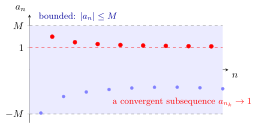
All terms lie in the band , yet the sequence does not converge: its terms keep jumping between the two halves of the band. The even-indexed terms, in red, form a subsequence that converges to , while the odd-indexed terms stay below the axis. The theorem promises at least one such subsequence; it does not say where its limit lies.
In the reason is repeated halving. One of the two halves of contains terms for infinitely many , one half of that half again, and so on; the nested intervals shrink to a point, and one term from each interval gives a subsequence converging to it. In the argument runs coordinate by coordinate.
Both parts of the setting are needed. Without boundedness the conclusion fails: has no convergent subsequence. Without the Euclidean metric it can fail too: under the discrete metric every set is bounded, but a sequence of distinct points has no convergent subsequence.
The limits of convergent subsequences are the accumulation points of the sequence, so a bounded sequence in has at least one accumulation point. In the second form, closedness keeps the limit inside , so closed and bounded sets are sequentially compact; with the equivalence of compactness and sequential compactness in metric spaces, this gives the Heine-Borel theorem.
Key Results
- The limit of a convergent subsequence is an accumulation point of the original sequence.
- In , every Cauchy sequence is bounded, so by Bolzano–Weierstrass theorem it has a convergent subsequence. A Cauchy sequence with a convergent subsequence must itself converge. This gives another proof that is complete.
Examples
- The sequence in is bounded between and . It does not converge, but it has two convergent subsequences: the even terms converge to , and the odd terms converge to .
- The sequence in is bounded in . It already converges to , so every subsequence also converges to .
Prerequisites
Related Concepts
Sources
- Math III: Analysis · Lecture 9
Aliases: Bolzano-Weierstrass theorem Keywords: sequential compactness theorem Symbols: real numbers
Last updated: 20 October 2026 07:29
Bolzano Weierstrass TheoremSequentially Compact SetOpen and Closed Sets in a Metric SpaceBounded Set in a Metric SpaceHeine-Borel TheoremSubsequence