Adherent Point and Closure of a Set
Definition
Let be a metric space and let be a subset of . A point in is termed an adherent point of if, for every , the ball intersects nonemptily. The set of all adherent points of constitutes the closure of , denoted as or .
Interpretation
An adherent point of a set is one that you can get arbitrarily close to from inside the set: every ball around it, however small, contains a point of the set. The closure is the original set together with all such points: everything you can touch or approach.
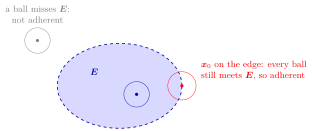
In the figure, the point inside is adherent because it belongs to itself; every point of is adherent. The point on the edge is adherent as well: each ball around it contains points outside but still meets . The grey point outside is not adherent, since one ball around it misses ; it is an exterior point.
Adherent points can be described with sequences: if and only if is the limit of a sequence in . If is adherent, pick , so that ; conversely, if with all , every ball around contains some .
The closure is the smallest closed set containing , and the points it adds are exactly the boundary points not already in . In Probability Theory, the support of a random variable with one of the usual densities is the closure of the region where the density is positive.
A common slip is to think that an adherent point must lie on the edge of or outside it. Every point of is adherent, including an isolated point such as in the interactive example, so always.
Key Results
- We have
- A set is closed if and only if it contains all its adherent points.
- The closure of a set is the intersection of all closed sets which contain , or equivalently, the smallest closed set that contains .
Examples
- The closure of in is . The endpoints and are adherent points even though they are not in the open interval.
- If in , the closure is . Zero is an adherent point approached by the sequence.
Prerequisites
Related Concepts
Sources
- Math III: Analysis · Lecture 5
Aliases: closure point, contact point Keywords: closure of a set Symbols: element of, epsilon, intersection, natural numbers, partial, real numbers, subset, union
Last updated: 20 October 2026 03:02
Adherent Point and Closure of a SetMetric and Metric SpaceSubsetOpen Metric BallOpen and Closed Sets in a Metric SpaceAccumulation Point in a Metric SpaceClosed Metric Ball