Extreme Value Theorem on Compact Sets
Theorem
Let be a function, and be a nonempty compact set. If is continuous on then attains both its maximum and minimum on
Interpretation
A continuous function on a compact set cannot sneak off to infinity or skip its highest and lowest values: it attains both a maximum and a minimum on that set.
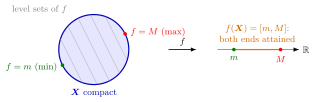
The level sets of are parallel lines, so increases steadily in one direction across the disc . The maximum is attained where the disc reaches furthest in that direction and the minimum on the opposite side. The image is the closed interval : along the segment from the minimum point to the maximum point, takes every value in between by the intermediate value theorem.
Each hypothesis is needed. On the set , which is not closed, has neither a maximum nor a minimum; on the unbounded set it has no maximum. Without continuity, can approach a value without reaching it: on , the function with for and has supremum but no maximum.
The proof combines two facts: the continuous image of a compact set is compact, and a nonempty compact subset of contains its supremum and infimum. For this is the extreme value theorem of Math I.
The theorem guarantees existence only. The extreme points need not be unique or interior; as in the figure, they may lie on the boundary, where setting derivatives equal to zero does not find them. The theorem returns in Math IV as the existence argument for a global maximum and minimum on a compact feasible set.
Key Results
- If the domain is not compact, the conclusion may fail. For example, on is continuous but has no maximum (it blows up as ) and no minimum (its values decrease towards as but is never attained, since ).
- This theorem is used to prove existence of solutions in optimization problems.
- Together with the intermediate value theorem, it gives a complete picture of the range of a continuous real-valued function on a connected compact set: the range is the closed interval between the minimum and the maximum . (In , a connected compact set is itself a closed bounded interval.)
Examples
- The function on the closed unit disc attains maximum at and minimum at .
Prerequisites
Related Concepts
Sources
- Math III: Analysis · Lecture 9
Symbols: element of, infinity, real numbers, square root, subset
Last updated: 20 October 2026 03:02
Extreme Value Theorem on Compact SetsGlobal Maximum and Minimum on \(\mathbb{R}^n\)Compact SetContinuity between Metric SpacesMaximum of a SetMinimum of a SetExtreme Value TheoremIntermediate Value Theorem on Connected Sets