Union and Intersection of Closed Sets
Proposition
For a metric space and a collection of closed subsets of , the countable intersection and the finite union are also closed.
Interpretation
Closed sets are preserved under finite unions and arbitrary intersections. Infinite unions can break closedness, because a limit of points from infinitely many sets need not lie in any one of them.
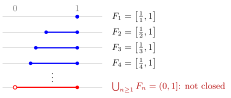
Each is closed, and their union over all is . The left endpoints all lie in the union and converge to , but lies in no , so the union misses a limit of its own points and is not closed. Finitely many never do this: is closed.
Both statements can be read through sequences, since a set is closed if and only if it contains the limits of its convergent sequences. A convergent sequence in lies in every , so its limit does too. A sequence in has infinitely many terms in one ; this subsequence has the same limit, which therefore lies in . With infinitely many sets no single set need contain a whole subsequence, as in the figure.
The proposition is also the mirror image of the union and intersection of open sets: taking complements turns intersections into unions and closed sets into open sets. Arbitrary intersections are why the intersection of all closed sets containing is itself closed; it is the closure of .
A common slip is to read the figure as "infinite unions of closed sets are never closed". They may or may not be: the union of all with is , which is closed. And is not open either.
Key Results
- Both and are always closed (and also open).
- In fact any intersection of closed sets, not just countably many, is closed. This holds for uncountable families as well.
Examples
- In , is closed. Shrinking closed intervals collapse to a single closed point.
- In , is not closed. It is missing the endpoint .
Prerequisites
Related Concepts
Sources
- Math III: Analysis · Lecture 6
Symbols: element of, infinity, integers, real numbers, union
Last updated: 20 October 2026 03:02
Union and Intersection of Closed SetsOpen and Closed Sets in a Metric SpaceCountable and Uncountable SetsUnion of SetsUnion and Intersection of Open Sets