Interior of a Set
Definition
For a metric space and a subset a point is an interior point of if there exists some such that We denote the set of interior points of as
Interpretation
An interior point of is a point that lies in with room to spare: some ball around it, however small, stays inside . From an interior point one can move a little in every direction without leaving the set.
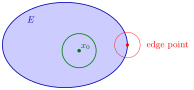
The green ball lies entirely inside , so its centre is an interior point. Every ball around the red edge point leaves , however small its radius, so that point is not interior but a boundary point. This does not depend on whether the edge point itself belongs to .
The radius may depend on the point. In the point is interior, but only balls of radius at most fit around it; what matters is that some positive radius works. Collecting all interior points gives the largest open subset of , and is open if and only if . Interior points of the complement are the exterior points of .
A common slip is to forget the ambient space. As a subset of , has interior . As a subset of the metric space with , every point is interior, because there .
This idea returns later: derivatives of functions of several variables, such as the gradient, are taken at interior points of the domain, where the function is defined in every direction around the point.
Key Results
- An interior point of is always in since balls centred at include
- The interior of is the largest open subset of .
Examples
- For , every point in is interior. Pick a small enough interval around any point and it stays inside .
- For , no point is interior. Any ball around contains numbers other than .
Prerequisites
Related Concepts
Sources
- Math III: Analysis · Lecture 5
Aliases: interior point Symbols: epsilon, real numbers, subset
Last updated: 20 October 2026 03:02
Interior of a SetBoundary of a SetDirectional DerivativeOpen Metric BallExterior of a Set