-norm and -metric
Definition
Let . For , the -norm, denoted , is defined on by:
For one sets , which is the limit of as .
Correspondingly, the -metric is defined as , that is,
The formula uses Exponentiation and Power twice: raise the coordinate magnitudes to , then take the power of their sum. The value is an Extended Real Number indexing the separate maximum-norm limit, not a finite exponent to substitute directly. Setting recovers the Euclidean Norm.
Interpretation
The -norm is a way of measuring the size of a vector by raising each coordinate's absolute value to the -th power, summing them, and taking the -th root. The exponent decides how much weight the large coordinates get: adds all coordinates equally, gives the Euclidean length, and as only the largest coordinate counts.
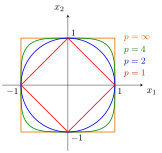
The figure compares the unit balls for . As increases, these balls expand from the diamond towards the square, because whenever . All four boundaries pass through and : a vector with a single nonzero coordinate has the same -norm for every .
The restriction is needed for the triangle inequality. For the formula gives but . Geometrically, the set is pinched inwards between the axes: it contains and , but not the midpoint , whose value is .
Different give different distances but the same analysis: from , all -norms on are equivalent, and the -metrics are strongly equivalent, with the same convergent sequences.
A common slip is to drop the outer root and use as the norm. For this is not a norm: it scales like instead of , so absolute homogeneity fails.
Key Results
- The smallest permissible value for in the -norm is .
Examples
- The Euclidean distance is a particular -metric when .
- The taxicab distance is a particular -metric when .
- The maximum norm is a particular -norm when .
Prerequisites
Related Concepts
- Euclidean Distance
- Taxicab Metric
- Maximum Norm
- Strongly Equivalent Metrics
- Discrete Metric
- Norm and Normed Vector Space
Sources
- Math III: Analysis · Lecture 4
Aliases: p norm, p metric, Minkowski distance Symbols: element of, infinity, real numbers, sum
Last updated: 22 October 2026 19:04
p-norm and p-metricExponentiation and PowerExtended Real NumberEuclidean NormEuclidean DistanceTaxicab MetricMaximum NormStrongly Equivalent MetricsDiscrete MetricNorm and Normed Vector Space