Intermediate Value Theorem on Connected Sets
Theorem
Let be a continuous real-valued function. Let be any connected subset of and let and be any two points in If is a real number between and then there exists a such that
Interpretation
A continuous function on a connected set cannot skip values: if it takes two different numbers, it must also take every number in between. The connected set takes over the role of the interval in the one-variable intermediate value theorem, and connectedness replaces "no gaps".
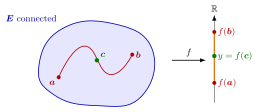
The points and of the connected region are sent to and on the real line. For the level between these values, the theorem gives a point with . The curve from to through shows the idea of the proof for path-connected sets in the Key Results: along a path, becomes a continuous function on .
In general, the proof uses that the image of a connected set is connected, and the connected subsets of are the intervals. An interval that contains and contains every number between them.
Both hypotheses are needed. On the disconnected set , the continuous function takes the values and but never . On the connected plane, the discontinuous function that equals for and for also skips .
A typical use is a sign change: if a continuous takes a negative and a positive value on a connected set , then the level set is nonempty. Similarly, a continuous function on a connected set that takes only integer values is constant.
Key Results
- Continuous image of a connected set is connected.
- If is path‑connected, the theorem can be proved by composing with a path and applying the one‑dimensional intermediate value theorem.
Examples
- Let be the closed unit disk in and . The image is which is also a connected set.
- Let be the unit sphere in and (height). The image is .
Prerequisites
Related Concepts
Sources
- Math III: Analysis · Lecture 10
Symbols: element of, real numbers
Last updated: 20 October 2026 03:02
Intermediate Value Theorem on Connected SetsConnected and Disconnected SetsContinuity between Metric SpacesIntermediate Value TheoremExtreme Value Theorem on Compact Sets