Maximum Norm
Definition
The maximum norm of in an -dimensional real coordinate space with fixed Cartesian coordinate system is:
Correspondingly, the Chebyshev distance between and is calculated as:
This is a norm because it is zero only at the zero vector, scales with absolute scalar size, and obeys the triangle inequality coordinate by coordinate. The induced distance is a metric distance. Comparison with the Euclidean Norm gives .
Interpretation
The maximum norm measures a vector by its largest coordinate in absolute value; the other coordinates do not matter as long as they are smaller. It is the limiting case of the -norm as .
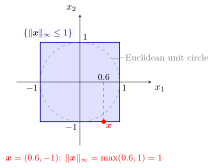
The square is the closed unit ball : a point lies in it exactly when both coordinates lie in . The marked point lies on the edge because its largest coordinate in absolute value is ; the coordinate does not change the norm. The dashed Euclidean unit circle lies inside the square, which is the inequality .
The Chebyshev distance is small if and only if every coordinate of is close to the corresponding coordinate of . This makes it convenient in proofs: says exactly that each coordinate sequence converges, and since the maximum norm is equivalent to the Euclidean norm, convergence in is the same as convergence of each coordinate.
For functions, taking the largest absolute value becomes the uniform norm : the values play the role of the coordinates, and the maximum becomes a supremum because there may be infinitely many of them.
A common slip is to take the maximum of the signed coordinates. The absolute values come first: , not .
Key Results
- The closed unit ball in the maximum norm is an axis-aligned hypercube
Examples
- .
- .
Prerequisites
Related Concepts
Sources
- Math III: Analysis · Lecture 4
Aliases: max norm, infinity norm on R^n Keywords: Chebyshev distance, maximum metric Symbols: infinity, real numbers, square root
Last updated: 20 October 2026 03:02
Maximum NormReal Coordinate SpaceNorm and Normed Vector SpaceMetric and Metric SpaceEuclidean Normp-norm and p-metricTaxicab MetricUniform Norm