Union and Intersection of Open Sets
Proposition
For a metric space and a collection of open subsets of , the countable union and the finite intersection are also open.
Interpretation
Open sets are preserved under arbitrary unions and finite intersections. Infinite intersections can break openness, because the balls that fit inside the individual sets may shrink to nothing.
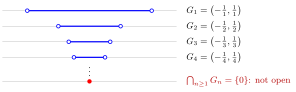
The point is interior to every , but the largest ball around inside has radius , and these radii tend to . No single ball around fits inside all , and indeed is not open in .
The proof is a statement about radii, using that a set is open if and only if all its points are interior points. A point of a union lies in some , and a ball around it inside also lies inside the union. A point of has balls of radius inside each , and the smallest of finitely many positive radii, , gives one ball inside all of them. With infinitely many sets the radii can have infimum , as in the figure.
Together with the openness of and , these two properties are the axioms of a topology. Taking complements gives the union and intersection of closed sets.
A common slip is to read the figure as "infinite intersections of open sets are never open". They may or may not be: is open. The proposition only says that openness is not guaranteed.
Key Results
- Both and are always open (and also closed).
- In fact any union of open sets, not just countably many, is open. This holds for uncountable families as well.
Examples
- In , is open. Even though each interval misses the right endpoint, the union still does not include 1.
- In , is closed. The intersection includes the endpoints 0 and 1, which are not interior points.
Prerequisites
Related Concepts
Sources
- Math III: Analysis · Lecture 6
Symbols: epsilon, infinity, intersection, real numbers
Last updated: 20 October 2026 03:02
Union and Intersection of Open SetsOpen and Closed Sets in a Metric SpaceCountable and Uncountable SetsUnion of SetsUnion and Intersection of Closed Sets