Path in a Metric Space
Definition
In a metric space , a path is a continuous function . If for two points , the path satisfies and , it is termed as a path from to .
Interpretation
A path is a continuous journey from one point to another within the space: the parameter runs through like time, and is the position at time . It is like drawing a curve without lifting your pencil, with the curve entirely contained in the space.
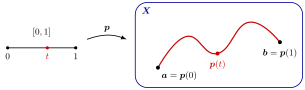
The interval on the left is the domain of , and the red curve in is its image. The start and the end are the endpoints of the curve, and an intermediate time is sent to the point on the way. Continuity of means that close times give close positions, so the curve has no jumps.
A path is the function , not only the curve it traces. Different paths can trace the same curve: runs through the same points as , at a different speed. A path may also stop, run back over itself or be constant, and it may have corners, since only continuity is required, not differentiability.
Paths define path-connectedness, and they reduce questions about a set to questions on : for a continuous real-valued , the composition is a continuous function of one variable. This is how the intermediate value theorem on connected sets can be proved for path-connected sets. Math IV studies differentiable curves through their velocity vectors and the chain rule on a curve.
Key Results
- If is a path from to and is a path from to , then it is possible to construct a path from to using and . This is called the concatenation.
- For any path from to , the reverse path is a path from to .
Examples
- In Euclidean space, the function is a path from to .
- The function is a path from back to itself (a loop).
Prerequisites
Related Concepts
Sources
- Math III: Analysis · Lecture 10
Symbols: element of, pi
Last updated: 20 October 2026 03:02
Path in a Metric SpacePath ConnectednessChain Rule on a CurveVelocity Vector of a CurveContinuity between Metric SpacesConnected and Disconnected Sets