Euclidean Space
Definition
A Euclidean space is a pair of a real vector space with and an inner product ; in other words, a finite-dimensional real inner product space.
The standard example, and the one meant by the Euclidean space , is the real coordinate space with the dot product .
Interpretation
Euclidean space is the setting for ordinary geometry in linear algebra. A vector space on its own only knows how to add and scale vectors; the inner product adds the measurements, namely lengths, distances and angles.
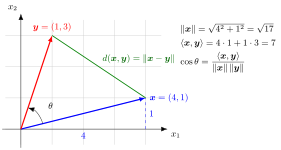
In with the dot product, every quantity in the figure comes from the inner product: the length , the inner product , the angle through , so , and the distance between the tips, .
Each part of the definition has a role. The space is real because lengths and angles are real numbers. It is finite-dimensional, which makes every Euclidean space look like , as the Key Results explain. And the inner product is part of the data: the same vector space with the inner product from the Examples has different lengths and angles, so its unit circle is an ellipse in the usual picture.
In with the dot product, the Euclidean norm, the Euclidean distance, the angle between vectors and orthogonality all come from this one inner product, and so does the description of planes and hyperplanes by normal vectors.
A common slip is to identify Euclidean space with the set . The set alone carries no geometry; it becomes the Euclidean space together with the dot product.
Key Results
- The inner product induces the norm and the distance ; on with the dot product these are the Euclidean norm and the Euclidean distance.
- The inner product also defines the angle between vectors and orthogonality.
- Every -dimensional Euclidean space is isomorphic to with the dot product by a linear bijection that preserves the inner product: write each vector in coordinates with respect to an orthonormal basis, a basis of mutually orthogonal unit vectors.
- Lines, planes, and hyperplanes are geometric objects in Euclidean spaces.
Examples
- with the dot product is the Euclidean plane; with the dot product is ordinary three-dimensional Euclidean space.
- with is also a Euclidean space; its unit circle is an ellipse in the usual picture of the plane.
Prerequisites
Related Concepts
Sources
- Math II: Linear Algebra · Week 5
- Math III: Analysis · Lecture 4
Keywords: Euclidean n-space, inner product space, finite-dimensional inner product space Symbols: infinity, real numbers, square root, theta
Last updated: 20 October 2026 03:02
Euclidean SpaceVector SpaceCoordinateEuclidean DistanceInner ProductReal Coordinate SpaceOrthonormal Basis