Complex Multiplication
Definition
Given two complex numbers and where , the product of complex numbers and is defined as
Interpretation
Multiplying two complex numbers works like multiplying two binomials: expand term by term and replace by . The term moves into the real part, which is why the real part of the product is .
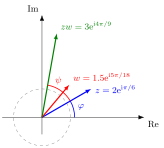
In the figure has length and angle , and has length and angle . The product has length and angle : the arc is the angle of , and the arc on top of it is the angle of , added on. In general complex multiplication multiplies the moduli, , and for nonzero and the arguments add modulo . So multiplying by stretches by the factor and rotates by the angle of .
The two descriptions suit different tasks. The Cartesian formula is the quickest way to compute a product such as ; the polar form shows what multiplication does to the picture and leads to De Moivre's formula for powers. Multiplying by the imaginary unit, which has length and angle , is a quarter turn; multiplying by a real number is a pure stretch.
A common slip is to multiply part by part, as in complex addition: is not . For that rule would give , but .
Key Results
- The multiplicative identity for complex numbers is which is the real number
- Complex multiplication has commutativity, associativity, and distributivity over complex addition.
- In polar form, complex multiplication combines stretching, because , with rotation, because arguments add modulo .
Examples
- .
- .
Prerequisites
Related Concepts
- Complex Addition
- Complex Reciprocal
- Polar Representation of Complex Numbers
- Imaginary Unit
- Distributivity
Sources
- Math II: Linear Algebra · Week 1
Aliases: multiplication of complex numbers, product of complex numbers Symbols: complex numbers, element of, phi, pi, psi, real numbers
Last updated: 20 October 2026 03:02
Complex MultiplicationComplex DivisionDe Moivre's FormulaComplex NumberComplex AdditionComplex ReciprocalPolar Representation of Complex NumbersImaginary UnitDistributivity