Linear Combination
Definition
Let be a collection of vectors and let be scalars. A linear combination is a vector of the form
Interpretation
A linear combination is built by scaling vectors and adding the results: scalar multiplication forms each , and vector addition combines these scaled vectors into a single vector of the same space. These are the only two operations a vector space provides, so the linear combinations are exactly the vectors that can be made from .
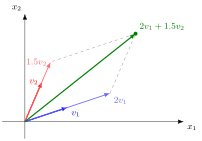
The figure builds in two stages. First is doubled and is stretched by ; then the two scaled vectors are added tip to tail, so the result is the diagonal of the parallelogram they form. Other coefficients give other points. Since and do not lie on one line, every point of the plane is reached by some choice of and .
The coefficients may be any scalars, including and negative numbers: and are linear combinations of and as well. In , deciding whether a vector is a linear combination of given vectors means finding coefficients that satisfy one linear equation per coordinate. For example, means and , so and .
Linear combinations are the common language of the next definitions: the span is the set of all of them, linear independence asks whether is reached only with all coefficients zero, and a basis reaches every vector in exactly one way.
Key Results
- Linear combinations are the building blocks of span, linear dependence, and bases.
- Many questions about the concept reduce to solving equations involving linear combinations.
Examples
- is a linear combination of and .
Prerequisites
Related Concepts
Sources
- Math II: Linear Algebra · Week 2
- Math V: Advanced Linear Algebra · Week 5 (revisited)
Keywords: linear superposition Symbols: alpha, real numbers
Last updated: 20 October 2026 03:02
Linear CombinationLinear Dependence and IndependenceLinear SpanParametric Representations of Lines and PlanesPlaneVector AdditionScalar MultiplicationSpanning ListSystem of Linear EquationsVector Space