Jordan Blocks and Chains
Definition
A Jordan block is a square matrix with eigenvalue on the main diagonal, s immediately above the diagonal, and s elsewhere.
A Jordan chain for eigenvalue of a square matrix is a sequence of generalized eigenvectors connected by
ending with an ordinary eigenvector and then .
Interpretation
Jordan blocks are the building pieces of Jordan normal form. A Jordan block of size at least is the simplest kind of matrix that is not diagonalizable: it has a single eigenvalue but only one independent eigenvector. Jordan chains explain where those blocks come from and how the generalized eigenvectors are ordered.
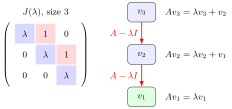
The figure shows of size next to a Jordan chain under , which then sends the eigenvector to . Only is an eigenvector; the others satisfy and . In the basis the columns of the matrix of are the coordinates of these images, , and , which is exactly . Each above the diagonal records one step along the chain.
Subtracting leaves only the s above the diagonal, and shifts: it sends the third basis vector to the second, the second to the first and the first to . Hence for a block of size . Its kernel is one-dimensional, so a block of size has algebraic multiplicity but geometric multiplicity . A block of size is just , with an ordinary eigenvector.
The order of the chain matters. Listing the basis as instead puts the s below the diagonal; the convention here starts the basis with the eigenvector.
Key Results
- A Jordan block is upper triangular and has one eigenvalue on its diagonal.
- The length of a Jordan chain corresponds to the size of the associated Jordan block.
Examples
- is a Jordan block.
- If , and , then is a Jordan chain of length .
Prerequisites
Related Concepts
Sources
- Math II: Linear Algebra · Week 6
Aliases: Jordan blocks, Jordan chains Keywords: Jordan block, Jordan cell, Jordan chain Symbols: lambda
Last updated: 27 October 2026 11:52
Jordan Blocks and ChainsJordan Normal FormEigenvalue and EigenvectorGeneralized EigenvectorAlgebraic and Geometric MultiplicityDiagonalizable MatrixKernel