Inner Product
Definition
For vectors and in , the dot product, or standard inner product, is
More generally, an inner product on a real vector space is a function that is
- symmetric: ;
- linear in the first argument, , and hence, by symmetry, in the second;
- positive definite: for every .
The dot product is an inner product on , and it is the one meant when Math II speaks of the inner product of two vectors in .
Interpretation
The inner product combines two vectors into one number that measures how much they point in the same direction. Length, distance, angle and orthogonality are all defined from it.
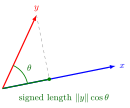
Dropping a perpendicular from the tip of onto the line of gives the green segment of signed length , where is the angle between the vectors and the Euclidean norm. The dot product is times this signed length, : positive for an acute angle as drawn, zero for a right angle, and negative for an obtuse angle, when the foot falls on the other side of the origin.
Each property in the general definition has a role: symmetry says the order does not matter; linearity, together with symmetry, lets inner products be expanded like products of numbers, as in ; positive definiteness gives every nonzero vector a positive length.
The Cauchy-Schwarz inequality and the triangle inequality follow from these properties alone, so they hold for every inner product. Dot products are also hidden in every matrix product: entry of is the dot product of row of with column of .
A common slip is to multiply entry by entry and stop there: the inner product is a number, not a vector, so , not .
Key Results
- , and if and only if .
- For real vectors, .
- Together with linearity, these are the defining properties of an inner product, so everything proved from them alone, such as the Cauchy-Schwarz inequality, holds for every inner product.
Examples
- .
- , so the vectors are orthogonal.
- is an inner product on different from the dot product.
Prerequisites
Related Concepts
Sources
- Math II: Linear Algebra · Week 5
- Math V: Advanced Linear Algebra · Week 5 (revisited)
Aliases: Euclidean inner product Keywords: dot product, standard inner product, scalar product, inner product space Symbols: alpha, beta, real numbers, theta
Last updated: 27 October 2026 11:52
Inner ProductAngle Between VectorsCauchy-Schwarz InequalityOrthogonal VectorsPoint-Normal Equation of a PlaneDirectional DerivativeGradientGram-Schmidt AlgorithmOrthogonal ComplementOrthogonal ProjectionOrthonormal BasisVectorEuclidean NormIdempotent MatrixVariance and Standard DeviationCoordinateEuclidean Space