Basis
Definition
A basis of a vector space is a collection of vectors that is linearly independent and spans .
Interpretation
A basis of is a list of vectors that is just right: it spans , so every vector can be built from it, and it is linearly independent, so none of its vectors can be built from the others. Together the two conditions mean that every vector of is a linear combination of the basis vectors in exactly one way. The coefficients of that combination are the coordinates of the vector.
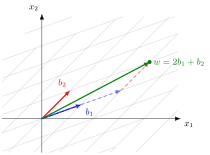
The two basis vectors and draw a slanted grid in the plane. The vector is reached by going twice along and once along , so and its coordinates in are . Because is a basis, every vector of has such a pair of coordinates, and no other pair gives the same vector.
Each condition prevents a different failure. Without spanning, some vectors have no coordinates at all: alone spans only the horizontal axis of . Without independence, coordinates are not unique: with the list , the vector is both and . So a basis is a spanning list that cannot be shortened, and an independent list that cannot be extended.
A nonzero vector space has many bases: the standard basis of is convenient, but the grid in the figure works just as well. In a finite-dimensional space all bases have the same length, the dimension.
Key Results
- Every vector in can be written uniquely as a linear combination of basis vectors.
- Any two bases of a finite-dimensional vector space have the same length.
Examples
- The standard basis of is .
Prerequisites
Related Concepts
Sources
- Math II: Linear Algebra · Week 2
- Math V: Advanced Linear Algebra · Week 5 (revisited)
Aliases: Hamel basis Keywords: basis vectors Symbols: real numbers
Last updated: 27 October 2026 11:52
BasisDimensionEigenbasisBasis of Solutions of a Difference EquationChange of BasisMatrix Representation of a Linear MapOrthonormal BasisLinear Dependence and IndependenceLinear SpanVector SpaceSpanning ListCoordinateDiagonalizable Matrix