Sum of Subspaces
Definition
If are subspaces of a vector space , their sum is
Interpretation
The sum of subspaces is the set of all vectors obtainable by adding one vector from each subspace. It is the natural way to combine subspaces: the union is usually not a subspace, and the sum also includes all vectors built from the two parts.
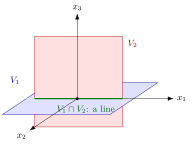
The figure shows two planes and through the origin of that cross in a line, their intersection . Adding a vector of to a vector of reaches every point of , so . The dimensions confirm this: for finite-dimensional subspaces, , here , where the line is subtracted because it is counted in both planes.
The sum is a subspace, and it is the smallest subspace containing every . Taking shows , and any subspace containing and must contain all sums . If each is the span of a list of vectors, then the sum is the span of all these vectors together.
Decompositions in a sum need not be unique. In the figure, a vector on the common line can be put entirely in or entirely in . When every vector of the sum has only one decomposition, the sum is called a direct sum.
Key Results
- The sum of subspaces is itself a subspace.
- It is the smallest subspace containing all the listed subspaces.
Examples
- The -axis plus the -axis in equals all of .
Prerequisites
Related Concepts
Sources
- Math II: Linear Algebra · Week 2
Keywords: Minkowski sum of subspaces Symbols: element of, intersection, real numbers, subset, union
Last updated: 22 October 2026 19:04
Sum of SubspacesDirect SumSubspaceLinear SpanDimension