Complex Absolute Value
Definition
Given a complex number where , the absolute value or modulus of , denoted , is the real number
Interpretation
The modulus measures the length of : its distance from in the complex plane. The square root in the definition is the nonnegative root, so , with only for .
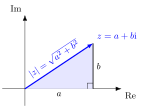
The arrow from to is the hypotenuse of a right triangle with a horizontal side of length and a vertical side of length , so by Pythagoras its length is . In another quadrant the sides have lengths and , which gives the same formula, since .
For a real number the formula gives , so the modulus extends the absolute value of real numbers, and the same notation is used. As for real numbers, is the distance between and .
A common slip is to compute as . The correct identity uses the conjugate, : for one has but .
The modulus is multiplicative, , so multiplying by stretches lengths by the factor . Together with the argument, the modulus gives the polar form of . The same Pythagorean length later measures vectors in , as the Euclidean norm.
Key Results
- While it is true that when is a real number, it does not hold whenever is a non-real complex number, i.e., for .
- The modulus is multiplicative, , and .
Examples
- .
- represents a unit circle in the complex plane.
Prerequisites
Related Concepts
Sources
- Math II: Linear Algebra · Week 1
Aliases: complex modulus, modulus of a complex number, magnitude of a complex number Symbols: complex numbers, element of, real numbers, square root
Last updated: 20 October 2026 03:02
Complex Absolute ValuePolar Representation of Complex NumbersComplex ReciprocalStability of a System of Linear Difference EquationsStability of a Scalar Difference EquationComplex Numbern-th RootComplex ConjugateEuclidean NormMetric and Metric SpaceAbsolute Value