Linear Span
Definition
The linear span of a collection is the set of all linear combinations of vectors in the collection, with scalars from the field of the vector space:
Interpretation
The span is everything that can be reached from the given vectors with linear combinations, that is, by scaling them and adding the results. It answers the question which vectors can be built from .
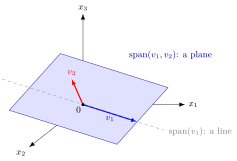
The figure shows the two typical shapes in . The multiples fill the dashed line through the origin, . Adding all multiples of , which points out of that line, fills the shaded plane . Both contain , the combination with all coefficients zero.
The span is always a subspace, and it is the smallest subspace containing : a subspace that contains these vectors is closed under addition and scalar multiplication, so it contains all their linear combinations. The span depends on what the vectors can produce, not on how many there are: the lists and both span , because adds no new direction. When the span is the whole space , the collection is a spanning list of .
A common slip is to confuse the span with the collection itself. The collection has vectors, while the span of one nonzero vector over already contains infinitely many. And since every span contains , a line or plane that misses the origin is never a span.
Key Results
- The span of any collection of vectors is a vector space.
- A collection spans if its span equals .
Examples
Prerequisites
Related Concepts
Sources
- Math II: Linear Algebra · Week 2
- Math V: Advanced Linear Algebra · Week 5 (revisited)
Aliases: span, linear hull Symbols: alpha, element of, real numbers, sum
Last updated: 27 October 2026 11:52
Linear SpanBasisSpanning ListRow SpaceLinear CombinationVector SpaceSubspace