Complex Addition
Definition
Given two complex numbers and where , the sum of complex numbers and is defined as
Interpretation
Complex numbers are added part by part: real parts with real parts and imaginary parts with imaginary parts. Nothing beyond the addition of real numbers is needed.
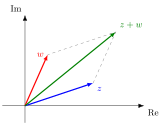
Draw and as arrows from . A copy of the arrow placed at the tip of ends at , since real parts and imaginary parts add separately. The two arrows and their copies form the dashed parallelogram, and is its diagonal from .
Because the addition works coordinate by coordinate, it is commutative and associative, is the identity and the negation is the inverse of , so is an Abelian group. Adding a fixed shifts every point of the plane by the same arrow; multiplication instead rotates and stretches. The parallelogram rule returns later for the addition of vectors.
Key Results
- The additive identity for complex numbers is which is the real number
- Complex addition has commutativity:
- Complex addition has associativity: .
Examples
- .
- .
Prerequisites
Related Concepts
Sources
- Math II: Linear Algebra · Week 1
Aliases: addition of complex numbers, sum of complex numbers Symbols: complex numbers, element of, real numbers
Last updated: 20 October 2026 03:02
Complex AdditionComplex SubtractionComplex NumberComplex MultiplicationCartesian Representation of Complex NumbersField