Algebraic and Geometric Multiplicity
Definition
If the characteristic polynomial factors as with distinct , then is the algebraic multiplicity of the eigenvalue , written .
The geometric multiplicity of an eigenvalue is the maximal number of linearly independent eigenvectors associated with , written .
Interpretation
Each eigenvalue comes with two counts. Algebraic multiplicity counts how often it appears as a root of the characteristic polynomial; geometric multiplicity counts how many independent eigendirections it actually has. The first is read from a formula, the second from the eigenvectors.
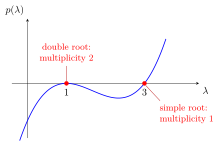
For , . The plotted differs from it by the constant factor and has the same roots. It touches the axis at the double root , where the factor does not change sign, and crosses it at the simple root , so and . Yet has rank , so its kernel is one-dimensional and .
The geometric multiplicity is the dimension of the eigenvectors for together with : , by the fundamental theorem of linear maps. It is at least , because every eigenvalue has an eigenvector, and never exceeds the algebraic multiplicity. Over the algebraic multiplicities add up to , by the fundamental theorem of algebra.
Comparing the two counts decides diagonalizability: every eigenvalue needs as many independent eigenvectors as its algebraic multiplicity. When , the missing directions are supplied by generalized eigenvectors, and is the number of Jordan blocks for in the Jordan normal form.
A repeated eigenvalue does not by itself prevent diagonalization. The identity has the double eigenvalue with , because every nonzero vector is an eigenvector; only is a problem.
Key Results
- For every eigenvalue of an matrix, .
- A matrix is diagonalizable if and only if for every eigenvalue, the eigenvalues being taken in so that the characteristic polynomial factors completely. A real matrix is diagonalizable over only if, in addition, all its eigenvalues are real.
Examples
- For , eigenvalue has algebraic multiplicity .
- For , eigenvalue has algebraic multiplicity but geometric multiplicity .
Prerequisites
Related Concepts
- Diagonalizable Matrix
- Jordan Blocks and Chains
- Jordan Normal Form
- linearly independent
- Eigenvalue-Root Theorem
Sources
- Math II: Linear Algebra · Week 6
Keywords: algebraic multiplicity, geometric multiplicity, multiplicity of an eigenvalue, eigenvalue multiplicity Symbols: complex numbers, lambda, real numbers
Last updated: 20 October 2026 03:02
Algebraic and Geometric MultiplicityCharacteristic PolynomialEigenvalue and EigenvectorDiagonalizable MatrixJordan Blocks and ChainsJordan Normal FormLinear Dependence and IndependenceEigenvalue-Root Theorem