Elementary Row Operation
Definition
An elementary row operation is one of three reversible operations on a system or matrix: adding a multiple of one row to another, interchanging two rows, or multiplying a row by a nonzero scalar.
Interpretation
Elementary row operations are the steps used to solve equations by hand, written for the rows of a matrix: swap two equations, multiply an equation by a nonzero number, or add a multiple of one equation to another. They transform a system without changing its solution set.
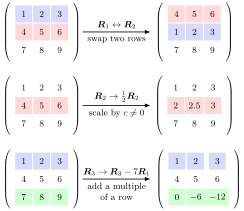
Each row of the figure applies one operation to the same matrix. Swapping and only reorders the rows; turns into ; and turns into , creating a zero below the first entry.
The solutions are kept because every operation can be undone by one of the same kind: a swap by the same swap, scaling by by scaling by , and adding to by adding , so the two systems are equivalent. The scalar must be nonzero: multiplying a row by replaces an equation by , which cannot be undone and can add solutions. Each operation can also be written as multiplication on the left by an elementary matrix, obtained by applying the same operation to the identity matrix.
The same operations drive the simplex pivot in OR Modelling. A common slip is to change two rows at once from the old rows: replacing by and at the same time by gives two rows that are negatives of each other, so one equation is lost.
Key Results
- Elementary row operations preserve equivalence of systems.
- Gauss-Jordan elimination consists of applying elementary row operations until reduced row echelon form is reached.
Examples
- Replace by .
- Swap and .
Prerequisites
Related Concepts
- Row Echelon and Reduced Row Echelon Form
- Pivot
- Inverse and Singular Matrices
- Equivalent Systems of Equations
- System of Linear Equations
- LU Decomposition
Sources
- Math II: Linear Algebra · Week 3
Aliases: row operation, elementary row transformation
Last updated: 27 October 2026 11:52
Elementary Row OperationGauss-Jordan EliminationRow SpaceMatrixRow Echelon and Reduced Row Echelon FormPivotInverse and Singular MatricesEquivalent Systems of EquationsSystem of Linear EquationsLU Decomposition