Subspace
Definition
Let be a vector space over a field . A subspace or linear subspace of is a nonempty subset that is itself a vector space using the same vector addition, scalar multiplication, and zero vector as .
Equivalently, is a subspace if is nonempty and for all and all ,
Interpretation
A subspace is a smaller vector space sitting inside a larger one, such as a line or a plane through the origin inside . The operations are not new: addition and scalar multiplication are inherited from the surrounding vector space, so the only question is whether they stay inside the subset.
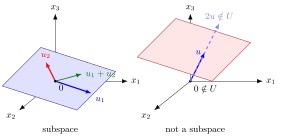
The left panel shows a plane through the origin: adding and gives , which again lies in the plane, and so does every multiple of a vector in it. The right panel shows a shifted plane that misses . It contains , but not , so scaling leaves and is not a subspace.
This is why closure matters. The single condition covers both operations: gives closure under addition, and gives closure under scalar multiplication. The other vector space rules, such as associativity, need no check, because they already hold in .
The zero vector is forced: since is nonempty, taking gives . This quick test rules out many affine-looking sets, such as shifted lines or planes not passing through the origin, even though they look geometrically similar. Containing is necessary but not sufficient: the two coordinate axes of together contain , but lies on neither axis. Typical subspaces are the span of some vectors and the solutions of an equation such as .
Key Results
- Subspace test: a nonempty subset is a subspace if and only if it is closed under all linear combinations of two of its vectors.
- Equivalently, is a subspace if it contains the zero vector and is closed under vector addition and scalar multiplication.
- The two trivial subspaces of are and itself.
- The kernel of a linear map is always a subspace of its domain, and the range is always a subspace of its codomain.
- Every subspace of a finite-dimensional vector space is finite-dimensional and has dimension at most that of the original space.
Examples
- The line is a subspace of because it contains and is closed under linear combinations.
- The set is not a subspace of because it does not contain the zero vector.
- The singleton set and the full space are the trivial subspaces of .
- A hyperplane through the origin is a subspace; a parallel shifted hyperplane is generally not.
Prerequisites
Related Concepts
Sources
- Math II: Linear Algebra · Week 2
- Math V: Advanced Linear Algebra · Week 5 (revisited)
Aliases: linear subspace, vector subspace Keywords: trivial subspace Symbols: alpha, beta, element of, real numbers, subset
Last updated: 20 October 2026 03:02
SubspaceDirect SumHyperplaneInvariant SubspaceKernelRange of a Linear MapSum of SubspacesAffine SubspaceOrthogonal ComplementVector SpaceFieldSubsetVector AdditionScalar MultiplicationZero VectorLinear SpanLinear Combination