Fundamental Theorem of Algebra
Theorem
The fundamental theorem of algebra states that every nonconstant polynomial with complex number coefficients has at least one root in .
Interpretation
The theorem says that is large enough to solve all nonconstant single-variable polynomial equations over . In , by contrast, has no solution.
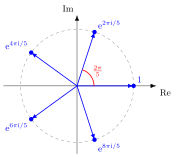
The figure shows the roots of , that is, the solutions of . By De Moivre's formula a solution must have modulus , since , and an angle for which is a multiple of . This gives five points on the unit circle, apart. Only is real: over the polynomial has one root, over it has five, as many as its degree.
The theorem guarantees only one root, but that is enough to find all of them. If is a root, polynomial long division by leaves remainder and a quotient of one degree lower, which again has a root if it is nonconstant. Repeating the step splits a polynomial of degree into linear factors, so it has exactly roots counted with multiplicity; has the single root , counted three times.
The word nonconstant is needed, since a nonzero constant polynomial has no root. The theorem says that roots exist, not how to compute them. For polynomials with real coefficients the non-real roots come in pairs by the complex conjugate root theorem, and in the language of fields the theorem says that is algebraically closed.
Key Results
- Every complex polynomial of degree has exactly roots when counted with multiplicity.
- Every complex polynomial of degree can be factored into linear factors over .
Examples
- has roots and in .
- has the root with multiplicity .
Prerequisites
Related Concepts
Sources
- Math II: Linear Algebra · Week 1
Aliases: FTA, d'Alembert-Gauss theorem, d'Alembert's theorem Symbols: complex numbers, lambda, phi, pi, real numbers
Last updated: 20 October 2026 03:02
Fundamental Theorem of AlgebraPolynomialComplex NumberRoot of a PolynomialAlgebraically Closed FieldPolynomial Long DivisionComplex Conjugate Root Theorem