Distance Between a Point and a Line
Definition
The distance between a point and a line is the shortest distance between and all points on the line.
Interpretation
The distance from a point to a line is the length of the shortest route from the point to the line. That shortest route is the perpendicular segment: the closest point on the line is the foot of the perpendicular from .
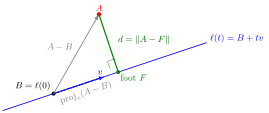
The line passes through in the nonzero direction . The vector splits into a part along (dashed, from to ) and a part perpendicular to (green, from to ), and the distance is the length of the second part, where
The foot is the closest point because of Pythagoras. For any other point on the line, is orthogonal to , so
which is larger than when . The same answer comes from minimizing the quadratic function with a derivative. Both arguments work in every . In there is also the formula , where is the cross product.
For a plane in through the roles swap: the distance from to the plane is the length of the part of along a normal vector, not the part perpendicular to a direction.
A common slip is to take , the distance to the given point of the line. It is only an upper bound for , reached when happens to be the foot.
Key Results
- The distance is zero if and only if the point lies on the line.
- In coordinates, the distance can be found by minimizing .
Examples
- For , a point on the line gives minimum distance .
- A point not on the line has positive distance.
Prerequisites
Related Concepts
Sources
- Math II: Linear Algebra · Week 5
Aliases: point-line distance, distance from a point to a line Symbols: real numbers
Last updated: 27 October 2026 11:52
Distance Between a Point and a LineEuclidean DistanceEuclidean NormParametric Representations of Lines and PlanesNormal VectorInner ProductPoint-Normal Equation of a Plane