Argument of a Complex Number
Definition
The argument of a nonzero complex number , denoted , is the angle between the positive real axis and the line joining the origin and . It is a multivalued function due to the periodicity of the angle in the polar coordinate system. The principal argument, denoted as , is the unique value of the argument that lies in the interval
Interpretation
The argument records the direction of a nonzero complex number , as the modulus records its length; together they are the polar coordinates of . Because a full turn brings a point back to itself, if is one argument of , then is another for every integer .
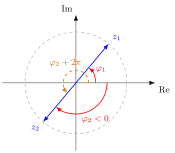
Both points lie on the same circle around the origin, so only their directions differ. For the angle is measured anticlockwise from the positive real axis. For in the lower half-plane the principal argument is measured clockwise and is negative, . The anticlockwise angle , that is , is also an argument of , but not the principal one, since it lies outside .
The principal argument picks one value, so that is a genuine function on the nonzero complex numbers. The interval is half-open so that every direction gets exactly one value: the negative real axis gets , not . The price is a jump there: points just above the negative real axis have close to , points just below it close to .
A common slip is to compute as . This is correct only for : for it gives , the direction of , while . The 2-argument arctangent handles all quadrants. The many values of are also why the complex logarithm has many values.
Key Results
- Each nonzero complex number has a unique principal argument. The argument of is undefined.
- For , the principal argument of is , where is the 2-argument arctangent.
Examples
- .
- .
Prerequisites
Related Concepts
Sources
- Math II: Linear Algebra · Week 1
Symbols: phi, pi
Last updated: 20 October 2026 03:02
Argument of a Complex NumberPolar Representation of Complex NumbersComplex Number2-Argument Arctangent