Periodic Function
Definition
Supplementary page
Periodicity is not a separate topic of Math I: Calculus. This page makes precise the word periodic used for the trigonometric functions and elsewhere on the wiki.
Let and let be a function. A number is a period of if, for every , also and , and
The function is periodic if it has a period. The smallest period, if one exists, is the fundamental period. The same definition is used for functions of a complex variable, where the period may be a nonzero complex number.
Interpretation
A periodic function repeats itself: its graph on any interval of length determines the whole graph, by shifting copies to the left and right. Periodic functions model cycles such as rotations, oscillations and seasonal patterns.
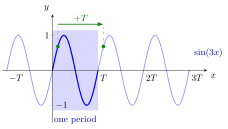
The graph is from the Examples, whose fundamental period is . The shaded window holds one period; every other part of the graph is a copy of it shifted by a multiple of . The two green points sit at some and at and have the same height, which is the defining equation .
Key Results
- If is a period of , then so is for every positive integer . So "the period" usually means the fundamental period.
- If is a period of and , then has period , since .
- Sums and products of functions with a common period also have period , though their fundamental period can be smaller: has fundamental period , not .
- A continuous periodic function on is bounded and attains its maximum and minimum: by the extreme value theorem it does so on , and every value is repeated there.
- A periodic function need not have a fundamental period: a constant function has every as a period, and the Dirichlet function has every positive rational number as a period, but no smallest one.
Examples
- and have fundamental period : and for all .
- has fundamental period : shifting by changes the sign of both and , so wherever .
- has fundamental period , by the scaling rule above.
- The complex exponential is -periodic: by Euler's formula, , so for every .
- The fractional part (floor function) has fundamental period .
Prerequisites
Related Concepts
- Trigonometric Functions
- Complex Exponential Function
- Euler's Formula
- Dirichlet Function
- Floor and Ceiling Functions
Sources
- Math I: Calculus · Lecture 4 (enrichment: supplements the trigonometric functions; not part of the course)
Aliases: period, periodicity Keywords: fundamental period, least period, periodic Symbols: complex numbers, element of, pi, real numbers, subset
Last updated: 17 October 2026 21:53
Periodic FunctionFunctionReal NumberTrigonometric FunctionsComplex Exponential FunctionEuler's FormulaDirichlet FunctionFloor and Ceiling Functions