Complex Exponential Function
Definition
Let . The complex exponential function is defined as
where denotes the -fold complex product of with itself (with ), which can be evaluated in polar form by De Moivre's formula.
Interpretation
For real inputs the series agrees with the real exponential function. Allowing complex inputs preserves the real exponential growth through .
The complex exponential is defined based on the Taylor series of the real exponential, extending its definition using powers of complex numbers.
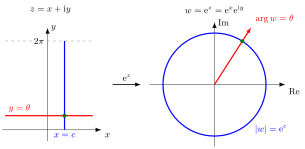
The modulus comes from the real part and the angle from the imaginary part, because with by Euler's formula: the line wraps onto the circle of radius , once per height (dashed), and the green point lands at . So is -periodic and never .
Key Results
- The series converges for all (infinite radius of convergence).
Examples
Prerequisites
Related Concepts
- Taylor Series — later development in Math III; the defining series is given above.
- Complex Exponentiation
- Euler's Identity
- De Moivre's Formula
- Periodic Function
Sources
- Math II: Linear Algebra · Week 1
Aliases: complex exponential, exponential of a complex number Symbols: complex numbers, element of, infinity, pi, sum, theta
Last updated: 17 October 2026 21:53
Complex Exponential FunctionComplex LogarithmEuler's FormulaComplex NumberExponential FunctionTaylor SeriesComplex ExponentiationEuler's IdentityDe Moivre's FormulaPeriodic Function