Homogeneous and Inhomogeneous Systems
Definition
Over or , a linear system is homogeneous if . It is inhomogeneous if .
Interpretation
The standard matrix form gathers all equations into . Homogeneity is the special choice in which the right-hand side is the zero vector, so the zero vector is automatically a solution.
A homogeneous system asks which vectors are mapped to zero. An inhomogeneous system asks which vectors are mapped to a specified nonzero right-hand side.
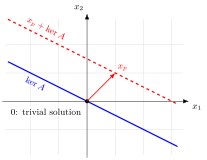
(here ): the solutions form the subspace , so is always a solution and solutions can be added and scaled; for (here ) the solution set is , for any one particular solution , or empty.
Key Results
- A homogeneous system always has at least the trivial solution .
- If a homogeneous system has more than one solution, then it has infinitely many solutions.
- An inhomogeneous system may have no solution, one solution, or infinitely many solutions.
Examples
- is homogeneous.
- with is inhomogeneous.
Prerequisites
Related Concepts
Sources
- Math II: Linear Algebra · Week 4
Keywords: homogeneous linear system, inhomogeneous linear system, nonhomogeneous system, inhomogeneous system Symbols: complex numbers, real numbers
Last updated: 27 October 2026 11:52
Homogeneous and Inhomogeneous SystemsGeneral Solution of a Linear ODEParticular Solution of an Inhomogeneous Linear ODEStandard Form of a Linear SystemZero VectorSystem of Linear EquationsKernelSolution SetLinear CombinationRank