Range of a Linear Map
Definition
Let be a linear map. The range or image of is .
Interpretation
The range is the part of the codomain that is actually reached by the map. For a matrix it answers the question for which right-hand sides the equation has a solution.
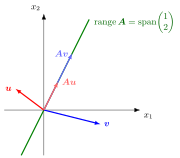
The matrix sends to . Both drawn vectors and land on the line through , and so does every other output: the range is the line spanned by the columns, not the whole plane.
The same computation works for any matrix: is the linear combination of the columns of with weights . Hence the range of is the span of the columns, also called the column space; is solvable exactly when lies in it, and its dimension is the rank of .
The word is used as for any function in Math I: the set of values actually taken, as opposed to the codomain, which only says where values may lie. A linear map is surjective if and only if its range is all of , and by the fundamental theorem of linear maps a kernel of larger dimension leaves a range of smaller dimension.
A common slip is to take the span of the rows instead of the columns. For the rows span the line through , but every output lies on the -axis.
Key Results
- The range of a linear map is a subspace of the codomain.
- A linear map is surjective exactly when its range equals the codomain.
Examples
- For on , the range is the -axis.
- The range of the zero map is .
Prerequisites
Related Concepts
Sources
- Math II: Linear Algebra · Week 4
- Math V: Advanced Linear Algebra · Week 5 (revisited)
Aliases: image of a linear map Keywords: range, image, column space Symbols: element of, real numbers, there exists
Last updated: 27 October 2026 11:52
Range of a Linear MapFundamental Theorem of Linear MapsRankFundamental Theorem of Linear AlgebraLeast SquaresLinear MapSubspaceKernelRange and Image