Symmetric Matrix
Definition
A symmetric matrix is a real square matrix satisfying . Equivalently, its entries satisfy for all .
Interpretation
The transpose exchanges entry with . Equality with the transpose therefore requires matching entries on the two sides of the diagonal, not merely matching diagonal entries.
A symmetric matrix is unchanged by reflection across its main diagonal.
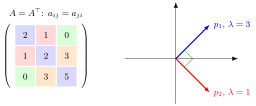
Read the left panel by pairing entries in positions and . Each pair must match; diagonal entries can have any real values. For instance, changing only while keeping fixed generally breaks symmetry. This entry-by-entry test is all that is needed here.
Later connection: eigenvectors (Week 6)
The right panel and the optional interaction below anticipate eigenvectors from Week 6. They are a consequence to revisit after learning that concept, rather than a test for understanding the present definition.
The eigenvectors of the symmetric matrix are orthogonal. In general a real symmetric matrix has real eigenvalues and an orthonormal eigenbasis: where is the diagonal matrix of eigenvalues and is orthogonal, , with mutually orthogonal unit eigenvectors as columns (spectral theorem).
Key Results
- Every real diagonal matrix is symmetric.
- If and are symmetric, then is symmetric, but need not be symmetric.
Examples
- is symmetric.
- is not symmetric.
Prerequisites
Related Concepts
Sources
- Math II: Linear Algebra · Week 3
Aliases: self-adjoint matrix Symbols: lambda
Last updated: 27 October 2026 11:52
Symmetric MatrixDefinite MatrixDefiniteness and EigenvaluesMoore-Penrose InverseSingular Value DecompositionSingular ValueMatrixTransposeQuadratic FormDiagonalizationEigenvalue and EigenvectorOrthonormal Basis