Cardinality
Definition
Two sets and have the same cardinality, written
if there exists a bijection
The empty set has cardinality A set has finite cardinality if it has the same cardinality as
Interpretation
Cardinality measures the size of a set through one-to-one correspondence. For finite sets this reproduces ordinary counting; for infinite sets it provides a precise way to compare sizes.
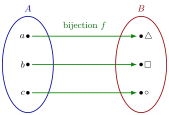
Each element of is joined to exactly one element of , and every element of is reached once, so the lines form a bijection and . No counting is needed to see that the sets are equally large: the pairing itself shows it, just as a room has as many chairs as people when everyone sits on a chair and no chair is empty.
Because the definition compares sets instead of counting them, it also works for infinite sets, with some surprising answers. and the even natural numbers have the same cardinality, although one is a proper subset of the other, because pairs them. To show that two sets do not have the same cardinality, one failed attempt is not enough: one must show that no bijection exists at all, as Cantor's diagonal argument does for and .
The infinite sizes have their own names: aleph null, , for the countably infinite sets such as , and , and the cardinality of the continuum, , for .
Key Results
- Having equal cardinality is an equivalence relation on sets.
- A finite set with distinct elements has cardinality
- Infinite sets can have the same cardinality even when one is a proper subset of the other.
- Cantor's theorem shows that every set has strictly smaller cardinality than its power set; here means that there is an injection but no bijection.
Examples
- and have the same cardinality.
- and the even natural numbers have the same cardinality because is a bijection.
- , , and are countably infinite, whereas is uncountable.
Prerequisites
Related Concepts
Sources
- Math II: Linear Algebra · Week 1
Aliases: equinumerous, equipotent, cardinal number Symbols: integers, natural numbers, rational numbers, real numbers
Last updated: 20 October 2026 03:02
CardinalityAleph NullCantor's TheoremCountable and Uncountable SetsCountingNaive ProbabilitySetBijection and Inverse FunctionFinite and Infinite SetsCardinality of the ContinuumDimensionEquivalence Relation