Jordan Normal Form
Definition
A Jordan normal form of a square matrix is a block diagonal matrix whose diagonal blocks are Jordan blocks, where is invertible and its columns are chains of generalized eigenvectors of . Every square matrix has a Jordan normal form over (more generally, whenever its characteristic polynomial splits into linear factors); it is unique up to the order of the blocks.
Interpretation
Jordan normal form is an almost diagonal form that still works when a matrix is not diagonalizable. It keeps the eigenvalues on the diagonal and uses s just above the diagonal to record where eigenvectors are missing.
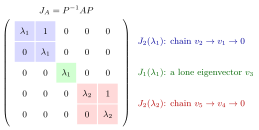
The figure shows a Jordan normal form with three Jordan blocks: from the chain , from a lone eigenvector , and from the chain . Here has algebraic multiplicity and geometric multiplicity , while has algebraic multiplicity and geometric multiplicity .
In general, the number of blocks for an eigenvalue is its geometric multiplicity, their total size is its algebraic multiplicity, and the block sizes are the lengths of the Jordan chains. The matrix is diagonalizable exactly when every block has size . The form exists over for every square matrix, but not always over : the quarter-turn rotation has no real eigenvalues.
Each block acts on the span of its own chain, an invariant subspace. Over , two square matrices and have the same Jordan normal form, up to the order of the blocks, exactly when for some invertible ; Math V calls such matrices similar.
The two multiplicities do not always fix the form. With and , the block sizes can be or ; deciding between them needs the lengths of the chains.
Key Results
- Jordan normal form is upper triangular with eigenvalues on the diagonal and possible s above the diagonal.
- If a matrix is diagonalizable, its Jordan normal form is diagonal.
Examples
- is a Jordan block.
- A diagonal matrix is already in Jordan normal form.
Prerequisites
Related Concepts
- Eigenvalue and Eigenvector
- Algebraically Closed Field
- Inverse Matrix
- Diagonalization
- Algebraic and Geometric Multiplicity
Sources
- Math II: Linear Algebra · Week 6
Aliases: Jordan canonical form, JCF, JNF, Jordan form Symbols: complex numbers, lambda, real numbers
Last updated: 20 October 2026 03:02
Jordan Normal FormMatrix ExponentialGeneralized EigenvectorMatrixJordan Blocks and ChainsEigenvalue and EigenvectorAlgebraically Closed FieldInverse and Singular MatricesDiagonalizationAlgebraic and Geometric Multiplicity