Complex Logarithm
Definition
A complex logarithm of a nonzero complex number is any complex number for which . Such a number is denoted by . If is given in polar form as , where and are real numbers, then is one logarithm of , and all the complex logarithms of are exactly the numbers of the form for integers For each nonzero complex number , the principal value of the complex logarithm is the logarithm whose imaginary part lies in the interval
Interpretation
A logarithm of answers the question: to which power must be raised to give ? For a real there is exactly one answer, the natural logarithm . For a complex there are infinitely many, because the complex exponential function is -periodic, , and therefore not injective.
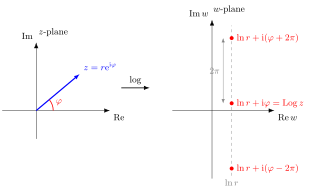
For one has : the real part of a logarithm records the modulus of , the imaginary part an argument. In the figure all logarithms of lie on the vertical line with real part in the -plane, spaced apart, one for each argument . The drawn angle lies in , so the marked middle value is ; with another choice of argument, is the value whose imaginary part lies in .
So is a function, and for a positive real it is the real . It inherits the jump of : crossing the negative real axis from above to below changes its imaginary part from nearly to nearly . For the same reason, the real rule holds for the multivalued only as an equality of sets of values; for it can fail by , as the Key Results show.
The logarithm is what defines complex powers, , and its many values are the source of the many values of .
Key Results
- For nonzero , the identity is not valid in general: the sum of principal arguments may lie outside . For example, taking gives , whereas . For positive real , the identity does hold.
Examples
- while
- while
Prerequisites
Related Concepts
- Argument of a Complex Number
- Euler's Formula
- Complex Exponentiation
- Logarithm and Logarithmic Function
Sources
- Math II: Linear Algebra · Week 1
Aliases: logarithm of a complex number Symbols: phi, pi
Last updated: 27 October 2026 11:52
Complex LogarithmComplex ExponentiationComplex Exponential FunctionPolar Representation of Complex NumbersComplex NumberArgument of a Complex NumberEuler's FormulaLogarithm and Logarithmic Function