Coordinate
Definition
In , if
then is called the th coordinate of .
Interpretation
The th coordinate of is the number in position of the tuple: it says how far to go along the th axis. Coordinates are the individual entries of a vector in real coordinate space, and two vectors of are equal if and only if all their coordinates agree.
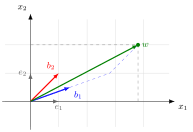
The figure shows that coordinates depend on the chosen basis. In the standard basis , the dashed grey lines drop from to on the -axis and to on the -axis, so and . Along the dashed blue path, the same vector is , so in the basis it has coordinates .
In a general vector space the vectors need not be tuples, and coordinates are defined through a basis: they are the coefficients of the unique linear combination of the basis vectors that gives the vector. The standard basis of makes those coefficients exactly the entries , since . For polynomials of degree at most with the basis , the coordinates of are . In the plane, the Cartesian coordinates of a point are the coordinates of the arrow from the origin to that point in the standard basis.
A coordinate is a number, not a vector: is a scalar, while is the vector that goes steps along the first axis.
Key Results
- A vector in has exactly coordinates.
Examples
- For , the second coordinate is .
Prerequisites
Related Concepts
Sources
- Math II: Linear Algebra · Week 2
Aliases: coordinate tuple Keywords: component, coordinates Symbols: real numbers
Last updated: 20 October 2026 03:02
CoordinateOriginReal Coordinate SpaceChange of BasisMatrix Representation of a Linear MapVector SpaceBasisVectorEuclidean SpaceCartesian Coordinate SystemInner Product