Idempotent Matrix
Definition
An idempotent matrix, or projection matrix, is a real square matrix satisfying .
Such a matrix projects onto its range: it maps every vector into the subspace and leaves every vector of that subspace unchanged. A projection matrix that is also symmetric, , is an orthogonal projection matrix; the others are oblique projections. In statistics and econometrics "projection matrix" usually means the orthogonal case, such as the hat matrix of least squares, for of full column rank.
Interpretation
The square is a matrix product, representing two successive applications of the same linear map. Idempotence says this composition equals one application.
Applying an idempotent matrix twice has the same effect as applying it once: projecting a vector that already lies in the subspace leaves it where it is.
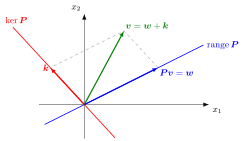
In the figure, gives , so vectors of stay fixed () and vectors of are sent to (). Every splits as with and (a direct sum), and . The only possible eigenvalues are and ; the projection need not be orthogonal (here it is oblique).
Key Results
- The zero square matrix and identity matrix are idempotent.
- If an idempotent matrix is invertible, then it equals the identity matrix.
- If is idempotent, then every vector splits as with and , so the space is the direct sum : projects onto its range along its kernel.
- If is idempotent, so is ; it projects onto along .
- The only possible eigenvalues of an idempotent matrix are and .
- An orthogonal projection matrix is symmetric and idempotent; then is the point of closest to , and is orthogonal to .
Examples
- , so is idempotent: it projects every vector onto the whole space.
- is idempotent and symmetric: the orthogonal projection onto the -axis.
- is idempotent but not symmetric: an oblique projection onto the -axis along the line spanned by .
Prerequisites
Related Concepts
Sources
- Math II: Linear Algebra · Week 5
Aliases: projection matrix, projector Keywords: projection, idempotent linear operator, hat matrix, projection operator, orthogonal projection, orthogonal projector, oblique projection Symbols: element of
Last updated: 27 October 2026 11:52
Idempotent MatrixMatrixMatrix ProductLinear OperatorEigenvalue and EigenvectorDiagonalizable Matrix