System of Linear Equations
Definition
A system of equations is an ordered collection of equations. A system of linear equations, or linear system, is a system whose equations can all be written in linear form.
The standard form of a linear system with equations and unknowns is
The coefficients form the coefficient matrix , the unknowns form the vector , and the right-hand sides form the vector , so the system can be written as .
Interpretation
A linear system packages several linear constraints into one problem: find all vectors that satisfy every equation at once. Matrix notation separates the structural information from the unknown vector and the right-hand side .
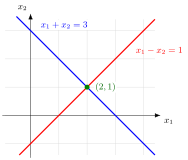
The illustrated system is and , or with and . Each equation describes a line, and their intersection is the solution.
"Linear" means that each unknown appears only to the first power, multiplied by a constant: , and are not linear, while is, since it can be rewritten as . The matrix form can be read in two ways. Row by row, row of with is one equation. Column by column, asks whether is a linear combination of the columns of .
In OR Modelling, a corner point of a two-variable linear program is found by turning two constraints into equations and solving them together, which is a linear system. A common slip is to expect infinitely many solutions whenever there are more unknowns than equations: , has three unknowns and no solution at all.
Key Results
- Over or , a linear system can have no solution, exactly one solution, or infinitely many solutions.
- The system is solved by applying row operations to its augmented matrix.
- The system is consistent if and only if the relevant ranks match: .
Examples
- is a system of equations.
- is a linear system.
Prerequisites
Related Concepts
- Row Echelon and Reduced Row Echelon Form
- Homogeneous and Inhomogeneous Systems
- Elementary Row Operation
- Linear Combination
- LU Decomposition
Sources
- Math II: Linear Algebra · Weeks 3–4
Aliases: linear system, simultaneous linear equations Keywords: system of equations, linear equation, coefficient matrix, right-hand side vector, rhs vector Symbols: complex numbers, real numbers
Last updated: 27 October 2026 11:52
System of Linear EquationsAugmented MatrixCramer's RuleEquivalent Systems of EquationsSolution SetStandard Form of a Linear SystemAffine SubspaceMatrixVectorRow Echelon and Reduced Row Echelon FormHomogeneous and Inhomogeneous SystemsElementary Row OperationLinear CombinationLU Decomposition