Scalar Multiplication
Definition
Scalar multiplication is the operation that takes a scalar and a vector and returns a vector .
Interpretation
Scalar multiplication rescales a vector by a number from the field: in a real coordinate space it stretches or shrinks the vector, a negative scalar also reverses its direction, and in coordinates every entry is multiplied by the same number, .
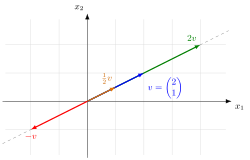
The figure shows with , twice as long, , half as long, and , the same length in the opposite direction. All multiples lie on the dashed line through the origin and , and as runs over they fill exactly this line.
The vector space axioms , and the two distributive laws tie it to the other operations; from them follow and . In a general vector space it acts on whatever the vectors are: for polynomials, . It is not a product of two vectors: the vector space axioms provide no such product, even though some spaces, such as polynomials, carry one as extra structure.
Key Results
- .
- .
Examples
- In , .
- For , reverses the direction and halves the length, while gives the zero vector.
Prerequisites
Related Concepts
- Zero Vector: multiplying any vector by the zero scalar gives the zero vector.
- Matrix Scalar Multiplication
- Vector
Sources
- Math II: Linear Algebra · Week 2
Aliases: multiplication by a scalar Symbols: alpha, beta, element of, real numbers
Last updated: 27 October 2026 11:52
Scalar MultiplicationLinear CombinationParametric Representations of Lines and PlanesSubspaceFieldVector SpaceZero VectorMatrix Scalar MultiplicationVector