Matrix Product
Definition
If has size and has size , the matrix product is the matrix with entries .
Interpretation
Matrix multiplication combines rows of the left matrix with columns of the right matrix and represents composition of linear maps: . The row-times-column rule is exactly what makes this hold.
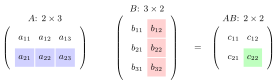
The entry is obtained by multiplying row of by column of . Both have three entries, which is why the inner sizes of the and matrices must agree; the outer sizes give the size of the product.
A second reading uses columns. If are the columns of , then is a linear combination of these columns, and column of is times column of . In the second Example, . With this reading, a linear system asks for a combination of the columns of that equals .
The order of the factors matters. When is defined, may not be, and even for square matrices the two usually differ: for and , but . A common slip is to multiply matrices entry by entry, as for matrix addition; that is a different operation.
Key Results
- The product is defined only when the number of columns of equals the number of rows of .
- Matrix multiplication is associative and distributive, but not generally commutative.
Examples
- A matrix times a matrix gives a matrix.
- .
Prerequisites
Related Concepts
Sources
- Math II: Linear Algebra · Week 3
- Math V: Advanced Linear Algebra · Week 1 (revisited)
Aliases: matrix multiplication, product of matrices Symbols: sum
Last updated: 20 October 2026 03:02
Matrix ProductIdempotent MatrixInverse and Singular MatricesQuadratic FormGeneralized InverseHigher-Order Linear Difference EquationKronecker ProductMatrix ExponentialMatrix Representation of a Linear MapSystem of Differential EquationsSystem of Linear Difference EquationsBonus-Malus Transition MatrixMarkov ChainMatrixProduct of Linear MapsLinear MapIdentity MatrixVectorDistributivity