Identity Matrix
Definition
The identity matrix is the matrix with on the main diagonal and everywhere else.
Interpretation
The identity matrix acts like the number for matrix multiplication: multiplying by it changes nothing. Its columns are the standard basis vectors of .
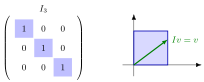
The left part shows with its ones on the main diagonal shaded. The right part shows the map in the plane, given by : the square and the vector stay where they are, since . As a linear map, is the identity function.
The reason is visible in the row-times-column rule: row of has a single , in position , so multiplying it with a column picks out the th entry of that column and nothing else. In the language of algebraic structures, is the identity element for multiplication of matrices. The subscript gives the size and is dropped when the size is clear from the product; for a non-square , the identity on the left and the one on the right have different sizes.
The identity matrix is also the target of Gauss-Jordan elimination: when the coefficient part of an augmented matrix has become , the system has a unique solution, which stands in the last column. Elementary matrices are obtained from by one row operation. The identity matrix returns later in the definition of the inverse matrix, .
Key Results
- For every matrix , and .
- The identity matrix is diagonal, symmetric, triangular, idempotent, and a permutation matrix.
Examples
- .
- .
Prerequisites
Related Concepts
Sources
- Math II: Linear Algebra · Week 3
- Math V: Advanced Linear Algebra · Week 1 (revisited)
Aliases: unit matrix Keywords: identity operator Symbols: real numbers
Last updated: 20 October 2026 03:02
Identity MatrixCharacteristic PolynomialGeneralized EigenvectorInverse and Singular MatricesMatrixLinear MapMatrix DiagonalsDiagonal Matrix