De Moivre's Formula
Theorem
For any integer and nonzero complex number , with , it holds that:
For positive integers , the identity also holds at . Negative powers require .
Interpretation
To raise a complex number in polar form to an integer power , raise its modulus to the power and multiply its angle by .
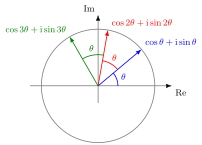
The figure shows the case : the powers of stay on the unit circle, and each multiplication adds the same angle , so the first, second and third powers lie at the angles , and . For the powers also move outwards and for inwards, which gives the spiral in the interactive version.
The formula follows from complex multiplication, which multiplies moduli and adds angles: multiplying by itself times gives modulus and angle . For negative one uses reciprocals, since has modulus and angle ; this is why is required there. In the Examples, has modulus and angle , so its eighth power has angle , the same direction as after subtracting , and equals .
The formula is stated for integers only. Used with , it gives different answers for different angles of the same number: has the angles and , and halving them gives and , the two square roots of . This is why fractional powers of complex numbers have several values. With Euler's formula the theorem reads .
Key Results
- The formula converts integer powers of a complex number into powers of its modulus and multiples of its argument.
- It is closely related to Euler's formula.
Examples
- .
- .
Prerequisites
Related Concepts
- Complex Number
- Root of a Polynomial
- Complex Exponential Function
- Complex Trigonometric Functions
- Complex Exponentiation
Sources
- Math II: Linear Algebra · Week 1
Aliases: de Moivre theorem, de Moivre's theorem Symbols: phi, pi, square root, theta
Last updated: 20 October 2026 03:02
De Moivre's FormulaPolar Representation of Complex NumbersComplex MultiplicationComplex NumberRoot of a PolynomialComplex Exponential FunctionComplex Trigonometric FunctionsComplex Exponentiation