Fundamental Theorem of Linear Maps
Theorem
Let be a finite-dimensional vector space and let be a linear map. Then
Interpretation
A linear map splits the dimension of its domain into directions lost to the kernel and directions that survive in the range. The kernel collects the input vectors sent to ; the dimension of the range counts the independent output directions that can actually be reached. The theorem says that these two counts always add up to .
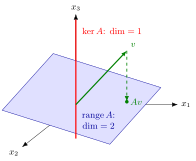
The map in the figure projects vertically onto the shaded plane, as drops onto . The whole vertical line is sent to , so , and the outputs fill the plane, so : .
For an matrix, read as a map , is the number of columns, is the rank, the number of pivots, and is the number of free variables of the homogeneous system . The theorem is then the count "pivot columns plus free columns equals all columns".
If , a linear map is injective if and only if it is surjective: a kernel of dimension leaves a range of full dimension. If , the range has dimension at most , so the kernel is nonzero; for example, a homogeneous system with more unknowns than equations always has a nonzero solution.
A common misreading is to picture kernel and range as two pieces of . The kernel lies in , but the range lies in ; only their dimensions add up.
Key Results
- The theorem is also called the rank-nullity theorem: the rank of is and its nullity is .
- It connects injectivity, surjectivity, and dimension for finite-dimensional vector spaces.
Examples
- If has a one-dimensional kernel, then its range has dimension .
- If is finite-dimensional, and , then , so and is bijective.
Prerequisites
Related Concepts
Sources
- Math II: Linear Algebra · Week 4
Aliases: rank-nullity theorem, dimension theorem Symbols: element of, real numbers
Last updated: 20 October 2026 03:02
Fundamental Theorem of Linear MapsFundamental Theorem of Linear AlgebraKernelRange of a Linear MapDimensionLinear MapRank