Euler's Formula
Theorem
For any , we have
Interpretation
Euler's formula connects the complex exponential with trigonometry. For a real angle it says that is the point of modulus one and angle in the polar coordinates of the complex plane.
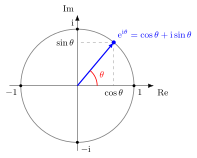
The point lies on the unit circle at the angle from the positive real axis, and the dashed lines meet the axes at its real part and its imaginary part . As grows the point runs anticlockwise round the circle: give the marked points , , and . So for every real : multiplying by is a rotation by , not a stretch.
The reason lies in the series defining the complex exponential and the complex sine and cosine. Substitute into the exponential series. The powers of repeat in the cycle , so the even terms contain no and alternate in sign, which gives the cosine series, while the odd terms all contain a factor and give times the sine series.
With the formula, the polar form becomes , and De Moivre's formula becomes ; the angle gives Euler's identity. The unit-circle reading is for real angles only. The formula holds for every complex , but then and need not be real and need not lie on the unit circle: for , .
Key Results
- We have and
- We have and
Examples
- When , we get the well-known Euler's identity.
Prerequisites
- Complex Exponential Function
- Complex Trigonometric Functions
- Complex Number
- Complex Plane Polar Coordinate System
Related Concepts
Sources
- Math II: Linear Algebra · Week 1
Symbols: complex numbers, element of, phi, pi, theta
Last updated: 20 October 2026 03:02
Euler's FormulaEuler's IdentityCharacteristic Equation for a Differential EquationStability of Solutions of Higher-Order ODEsComplex Exponential FunctionComplex Trigonometric FunctionsComplex NumberPolar Representation of Complex NumbersDe Moivre's FormulaComplex ExponentiationEuler's Number