Skip to content

Product of Linear Maps

Definition

If A∈L(V,W)\boldsymbol{A}\in\mathcal{L}(V,W) and B∈L(U,V)\boldsymbol{B}\in\mathcal{L}(U,V), the product AB∈L(U,W)\boldsymbol{A}\boldsymbol{B}\in\mathcal{L}(U,W) is the composition defined by (AB)(u)=A(Bu)(\boldsymbol{A}\boldsymbol{B})(\boldsymbol{u})=\boldsymbol{A}(\boldsymbol{B}\boldsymbol{u}).


Interpretation

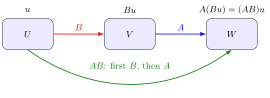
The product AB\boldsymbol{A}\boldsymbol{B} of two linear maps is their composition as functions: first apply the map on the right, B\boldsymbol{B}, then the map on the left, A\boldsymbol{A}. It is written as a product because, for matrices, composition is exactly matrix multiplication.

Three spaces U, V and W in a row with arrows B from U to V and A from V to W, and a curved arrow AB from U to W: first B, then A.

The figure reads from left to right: B\boldsymbol{B} takes u∈U\boldsymbol{u}\in U to Bu∈V\boldsymbol{B}\boldsymbol{u}\in V, and A\boldsymbol{A} takes that vector on to A(Bu)∈W\boldsymbol{A}(\boldsymbol{B}\boldsymbol{u})\in W. The curved arrow is the single map AB ⁣:U→W\boldsymbol{A}\boldsymbol{B}\colon U\to W that does both steps at once. The middle space must match: B\boldsymbol{B} has to land in VV, where A\boldsymbol{A} is defined, otherwise A(Bu)\boldsymbol{A}(\boldsymbol{B}\boldsymbol{u}) has no meaning.

The composition is again linear: B\boldsymbol{B} turns u+v\boldsymbol{u}+\boldsymbol{v} into Bu+Bv\boldsymbol{B}\boldsymbol{u}+\boldsymbol{B}\boldsymbol{v}, and A\boldsymbol{A} turns that into ABu+ABv\boldsymbol{A}\boldsymbol{B}\boldsymbol{u}+\boldsymbol{A}\boldsymbol{B}\boldsymbol{v}; scalar multiples pass through both maps in the same way. For matrices, [AB]=[A] [B][\boldsymbol{A}\boldsymbol{B}]=[\boldsymbol{A}]\,[\boldsymbol{B}], and the matching middle space becomes the size condition: A\boldsymbol{A} is m×nm\times n and B\boldsymbol{B} is n×kn\times k. Composition is associative, since (AB)C(\boldsymbol{A}\boldsymbol{B})\boldsymbol{C} and A(BC)\boldsymbol{A}(\boldsymbol{B}\boldsymbol{C}) both mean "first C\boldsymbol{C}, then B\boldsymbol{B}, then A\boldsymbol{A}".

A common slip is to apply A\boldsymbol{A} first because it is written first. The order matters: on R2\mathbb{R}^2, let A(x1,x2)=(x1,0)\boldsymbol{A}(x_1,x_2)=(x_1,0) and let B(x1,x2)=(x2,x1)\boldsymbol{B}(x_1,x_2)=(x_2,x_1) swap the coordinates. Then AB(x1,x2)=(x2,0)\boldsymbol{A}\boldsymbol{B}(x_1,x_2)=(x_2,0) but BA(x1,x2)=(0,x1)\boldsymbol{B}\boldsymbol{A}(x_1,x_2)=(0,x_1), so AB≠BA\boldsymbol{A}\boldsymbol{B}\neq\boldsymbol{B}\boldsymbol{A}, just as composition of functions is not commutative.

Key Results

  • The product of compatible linear maps is linear.
  • Matrix multiplication represents composition of linear maps.

Examples

  • If B ⁣:R→R2\boldsymbol{B}\colon\mathbb{R}\to\mathbb{R}^2 and A ⁣:R2→R\boldsymbol{A}\colon\mathbb{R}^2\to\mathbb{R}, then AB ⁣:R→R\boldsymbol{A}\boldsymbol{B}\colon\mathbb{R}\to\mathbb{R}.
  • For matrices, ABx=A(Bx)\boldsymbol{A}\boldsymbol{B}\boldsymbol{x}=\boldsymbol{A}(\boldsymbol{B}\boldsymbol{x}).

Prerequisites

Sources

Aliases: composition of linear maps, composition of linear transformations Symbols: element of, real numbers

Last updated: 20 October 2026 03:02