Characteristic Polynomial
Definition
For a square matrix , the characteristic polynomial is , viewed as a polynomial in . The equation is called the characteristic equation.
Interpretation
The characteristic polynomial turns the search for eigenvalues into a polynomial equation. A number is an eigenvalue when sends some nonzero vector to , and the determinant detects exactly this: it is zero when the matrix is singular.
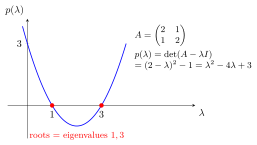
For , . The parabola crosses the horizontal axis at and , and these roots are the eigenvalues of , with eigenvectors and .
The identity matrix is needed because is a number and a matrix: subtracts from the diagonal entries only. Expanding the determinant gives a polynomial of degree ; for a matrix it is , with the trace as a coefficient. Some texts use instead, which differs by the factor and has the same roots.
For a real matrix the polynomial has real coefficients, so the results on polynomials apply. By the fundamental theorem of algebra it has complex roots counted with multiplicity, and nonreal roots come in conjugate pairs. The quarter-turn rotation has characteristic polynomial and eigenvalues , but no real eigenvalue. The multiplicity of a root is the algebraic multiplicity of that eigenvalue.
A common slip is to subtract from every entry, or to compute . Only the diagonal is shifted, and the determinant is taken after the shift.
Key Results
- The eigenvalues of are exactly the roots of the characteristic polynomial, equivalently the solutions of the characteristic equation.
- For an matrix, the characteristic polynomial has degree .
Examples
- For , the characteristic polynomial is .
- For , the characteristic polynomial is .
Prerequisites
Related Concepts
- Root of a Polynomial
- Diagonalization
- Eigenvalue and Eigenvector
- Complex Conjugate Root Theorem
- Distinct Eigenvalues Theorem
Sources
- Math II: Linear Algebra · Week 6
- Math V: Advanced Linear Algebra · Week 1 (revisited)
Keywords: characteristic equation Symbols: lambda
Last updated: 20 October 2026 03:02
Characteristic PolynomialAlgebraic and Geometric MultiplicityEigenvalue-Root TheoremCharacteristic Polynomial for a Difference EquationComplex Conjugate Pair of EigenvaluesSimilarity TransformationMatrixDeterminantIdentity MatrixPolynomialRoot of a PolynomialDiagonalizationEigenvalue and EigenvectorComplex Conjugate Root TheoremDistinct Eigenvalues Theorem